The All Souls Procession is Tucson's great public ritual of remembrance: tens of thousands of people walking for their dead, and an urn of written prayers burned at the finale. The 2026 All Souls Weekend runs Friday, November 6 through Sunday, November 8, with the Main Procession on Sunday, November 8. Dates verified against allsoulsprocession.org as of July 2026.
One disclosure shapes everything else on this page: Freaky Foot Tours has no affiliation with the All Souls Procession or with Many Mouths One Stomach, the nonprofit that produces it. We are an Arizona family-owned and operated tour company with guided tours in Flagstaff, Prescott, and Tucson, and our guests ask about the Procession every fall. This page is our answer: what it is, when it runs in 2026, and how to be a good guest at another community's ceremony.
What the All Souls Procession is, and what it is not
Start with the organizers' own framing, because it settles most questions before they start: the All Souls Procession is a funeral ceremony. It is not a parade with floats to cheer, not a Halloween event, not a street festival that happens to involve face paint, and, by the organizers' explicit request, not a political stage. It is a ceremony built for participants rather than spectators: anyone may walk, individuals need no registration, and there is no ticket because there is nothing to buy. Tens of thousands of people walk it carrying photographs, painted faces, small altars, and the names of the people they have lost.
It is also not, strictly speaking, a Día de los Muertos event, and the organizers are careful on this point. They present the Procession as inclusive of, but distinct from, Day of the Dead: it was born in Tucson's arts community in 1990, and it holds space for many funerary traditions, with Día de los Muertos, Japanese Obon, and Samhain among those the organizers name. That framing was adopted deliberately, partly in response to concerns about cultural appropriation, and a respectful visitor keeps the distinction in mind. You are attending a Tucson ceremony with its own history, not a costume version of someone else's.
One artist's grief, 1990
The Procession began as one person's mourning. In 1990, Tucson artist Susan Kay Johnson, grieving her father's death, created a ceremonial procession as a performance piece, drawing on her background in art therapy and on the role ritual plays in grief. The first walk was small, roughly fifteen participants, moving through the days between Halloween and All Souls Day. By 1991 she had grant support to open it to wider community involvement, and Tucson took the invitation seriously.
The 2026 gathering is billed as the 37th annual All Souls Weekend, and the Procession now draws well over 100,000 participants, with attendance figures varying by source and the organizers' own history putting recent years higher still. Since 2006 it has been produced by Many Mouths One Stomach, a grassroots Tucson nonprofit arts collective, funded by donations and grants. The organizers decline corporate sponsorship, which is why the event has no banners to walk under and no brand to thank, and why the donation buckets matter more than most.
The Urn
At the center of the Procession, literally and otherwise, is the Urn: a large steel sculptural vessel that serves as the walk's focal point. Through the weekend, participants write out prayers, remembrances, and offerings for their dead, and the slips are collected into the Urn. At the finale in the Mercado District, in a ceremony the organizers currently call the Restoration of Care, the Urn's contents are burned before the crowd. The fire is the point of the whole weekend. Everything written, carried, and grieved along those two miles goes up together, publicly, and a year's mourning is given somewhere to go.
When and where it runs in 2026
The 2026 All Souls Weekend runs Friday, November 6 through Sunday, November 8, and the Main Procession is Sunday, November 8. As currently published by the organizers, assembly begins at 4 PM on Grande Avenue, on Tucson's west side south of Speedway Boulevard, and the procession departs at 6 PM. The route moves south on Grande, turns onto Congress Street, and ends in the Mercado District, where the finale and the burning of the Urn take place: about two miles on foot, through some of Tucson's oldest neighborhoods. The route has shifted over the years, so treat this as the current shape rather than a promise. The route map and schedule of record live at allsoulsprocession.org, and everything in this section was verified against that site as of July 2026.
Getting there is easier without a car. The organizers recommend the Sun Link streetcar, Sun Tran Route 22, or parking downtown and walking over, and designated rideshare stations are published with the route map. A livestream runs for those who cannot attend in person. Expect closed streets and dense crowds at the assembly and finale points, and plan for more walking than you think.
How to attend respectfully
Most of what follows is drawn from the organizers' published guidance, and the rest is common sense dressed for a funeral. Both roles are welcome: walk in the procession, or watch quietly from the sidewalks. The organizers are direct that the ceremony rewards participation, and that no one needs an invitation to join.
- Dress and act for a ceremony. Costumes, masks, painted faces, altars, and puppets are invited by the organizers, and they are worn in earnest: this is a funeral, not a costume contest.
- Give people room to grieve. Some of the walkers are carrying very recent losses.
- Keep the neighborhoods intact: no blocked driveways, no trampled gardens, no litter left along the route.
- Leave politics at home. The organizers ask that the ceremony not be used as a stage.
- It is free to attend. Donations to the nonprofit that produces it are what keep it running.
On photography, the organizers' published guidance is quiet, so what follows is our own rule and we own it: grief is not a photo prop. Photograph the spectacle, the Urn, the lights, the scale, the crowd as a crowd, and not strangers in their mourning. If you want a close portrait of a painted face, ask first, and take no for an answer.
The organizers describe the event as family-friendly, and they mean it: children walk, elders walk, and pets are permitted. Accessible seating is available near the finale stage, and the one honest caution is crowd density, which at the assembly and finale points can be difficult for anyone with limited mobility.
The rest of the weekend
The Main Procession is the center of gravity, but All Souls Weekend carries several events around it: a Community Altar Dedication Ceremony, two nights of Dance of the Dead concerts, the Procession of Little Angels, which is the family-oriented procession of the weekend, and an official after party following the finale. We are deliberately not printing days and times for these. The smaller events move around the weekend from year to year, and published sources do not yet agree on the 2026 schedule. The organizers' site is the schedule of record; check it in the weeks before you travel.
Making a November weekend of it
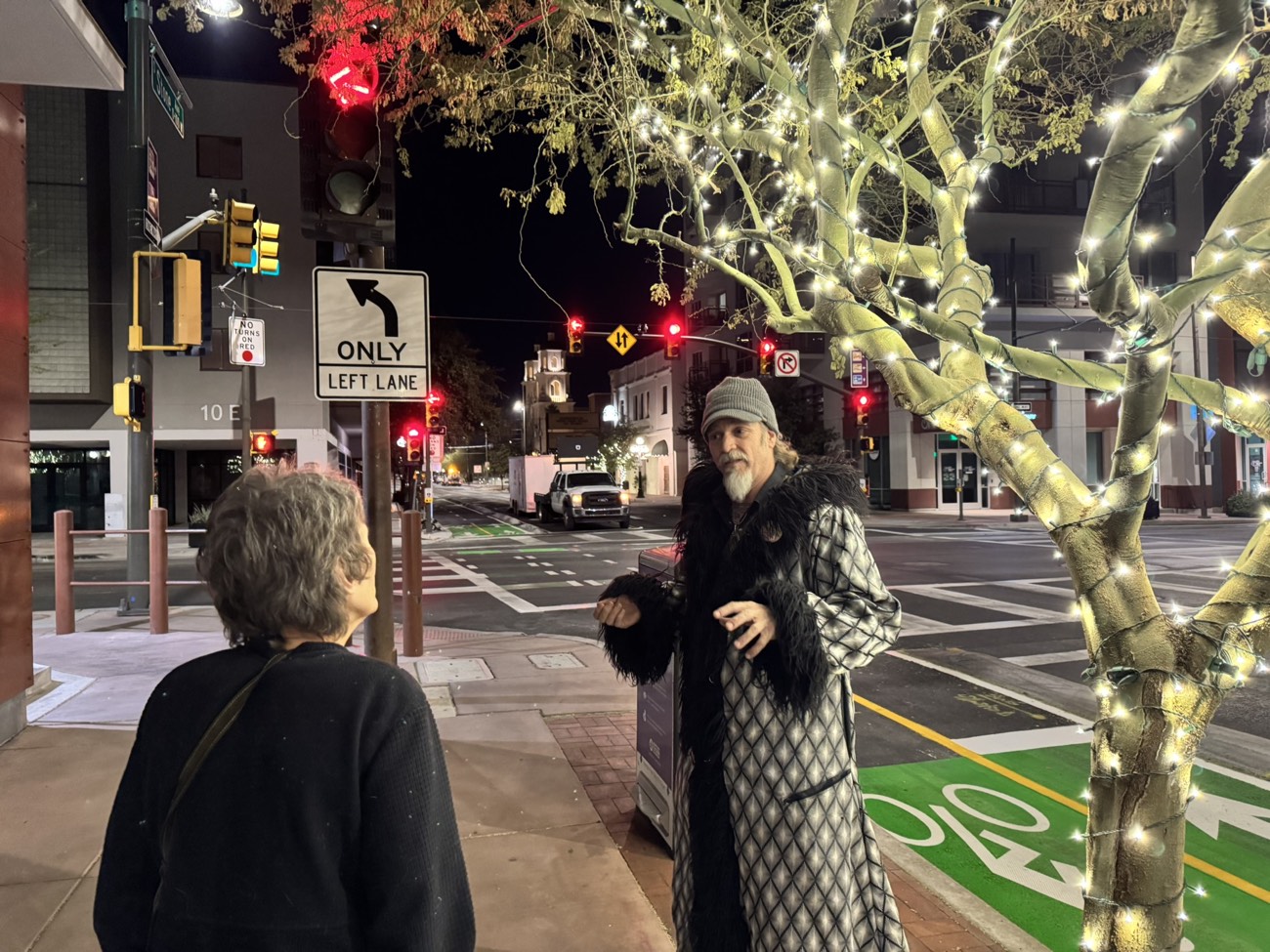
Here is the quiet argument for building a whole Tucson weekend around the Procession: early November is when this city is at its best. The summer heat has broken, the evenings are made for walking, and downtown stays lit and busy after dark. The Procession claims Sunday. That leaves the other evenings, and Tucson fills them easily: our guide to things to do in Tucson at night covers the Congress Street evening in full, and if your trip starts a week earlier, our Halloween in Tucson page covers the run-up, with the rest of the state in Halloween in Arizona. Everything else we run in the city is on our Tucson page.
Two stops belong on the itinerary for anyone the Procession moves. The first is El Tiradito, the wishing shrine at the edge of Barrio Viejo: the same city, the same candles, the same instinct to remember, kept at neighborhood scale every night of the year. Go in the evening, when the candles are lit, and read our page on it before you visit, because the etiquette matters there too. The second is the evening walk we run ourselves, covered below.
Questions people ask
When is the All Souls Procession in 2026?
The Main Procession is Sunday, November 8, 2026, and the full All Souls Weekend runs Friday, November 6 through Sunday, November 8. As currently published, assembly begins on Grande Avenue at 4 PM and the procession departs at 6 PM. Those details were verified against allsoulsprocession.org as of July 2026; check the organizers' site for the current schedule before you go.
Is the All Souls Procession the same as Día de los Muertos?
No. The organizers present the Procession as inclusive of, but distinct from, Día de los Muertos. It began in Tucson's arts community in 1990 and holds space for many funerary traditions, with Día de los Muertos, Japanese Obon, and Samhain among those the organizers name.
Can anyone walk in the All Souls Procession?
Yes. Individuals need no registration and no ticket; you join the assembly and walk. Large musical groups and floats register with the organizers in advance. Watching quietly from the sidewalks is welcome too, though the organizers are clear that the ceremony is built for participants.
Is the All Souls Procession free?
Yes. The event is free to attend and free to walk. It is produced by Many Mouths One Stomach, a Tucson nonprofit arts collective, and funded by donations and grants rather than corporate sponsorship, so donations are what carry it from year to year.
Where does the procession start and end?
As published for 2026, the procession assembles on Grande Avenue on Tucson's west side, moves south on Grande, turns onto Congress Street, and ends in the Mercado District, where the finale and the burning of the Urn take place. The walk covers about two miles. Organizers recommend the Sun Link streetcar, Sun Tran Route 22, or parking downtown and walking over.
What is the urn at the All Souls Procession?
The Urn is a large steel sculptural vessel that serves as the Procession's focal point. Through the weekend, participants write prayers, remembrances, and offerings for their dead, which are collected into the Urn and ceremonially burned at the finale in the Mercado District, a ceremony the organizers currently call the Restoration of Care.
Is the All Souls Procession appropriate for kids?
Yes. The organizers describe the event as family-friendly, and the Procession of Little Angels is the weekend's family-oriented procession. Prepare children for what they will see: painted faces, candlelight, and open grief, treated as ordinary. Check the official schedule at allsoulsprocession.org for the current day and time of the Little Angels event.
If you are in Tucson that weekend
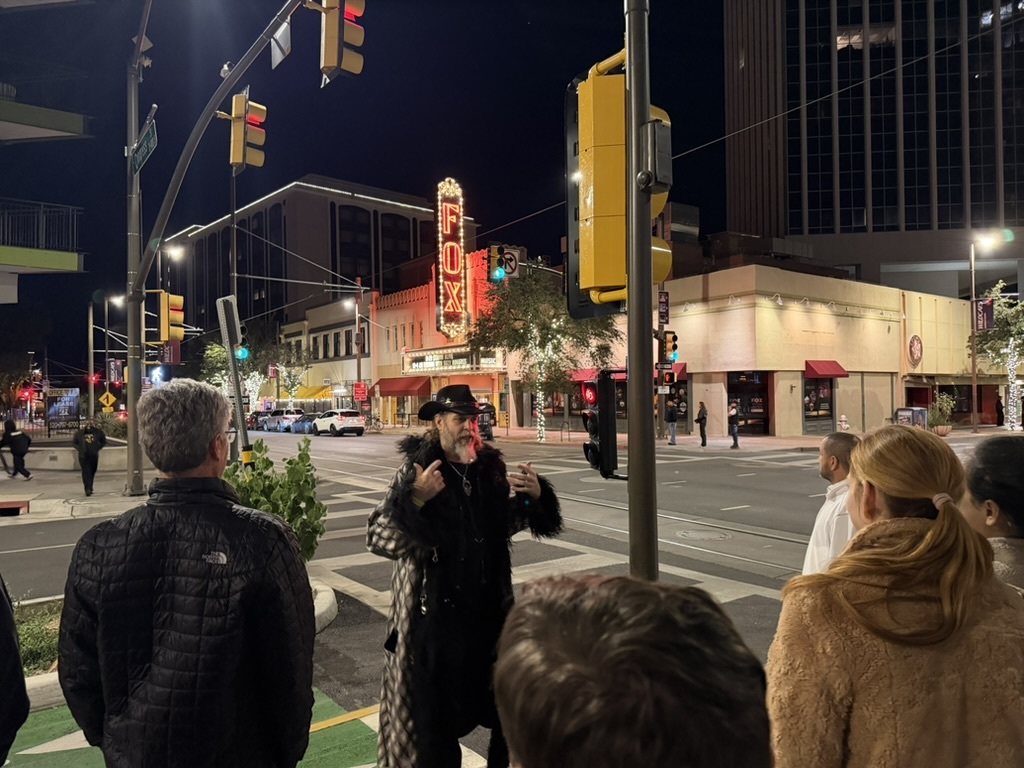
The Procession is the headline of the weekend; our part is the companion evening. The Downtown Tucson Haunted History Tour covers 90 minutes and about a mile through downtown, eight stops, meeting at Hotel Congress, 311 E Congress St, with nightly departures at 8 PM; current departure times are in the booking calendar on the tour page. Tickets are $29 for adults, $25 for students and $22 for children, and the tour holds a 4.7 of 5 rating across 25+ TripAdvisor reviews for this tour as of September 2026. Booking is straightforward: full refund when canceled 24 or more hours before the tour, no refund inside 24 hours. It is a different register from the Procession, stories told for an audience rather than a ceremony, and we keep it that way on purpose: one evening for Tucson's documented history and reported hauntings, and Sunday for the city's living act of remembrance.