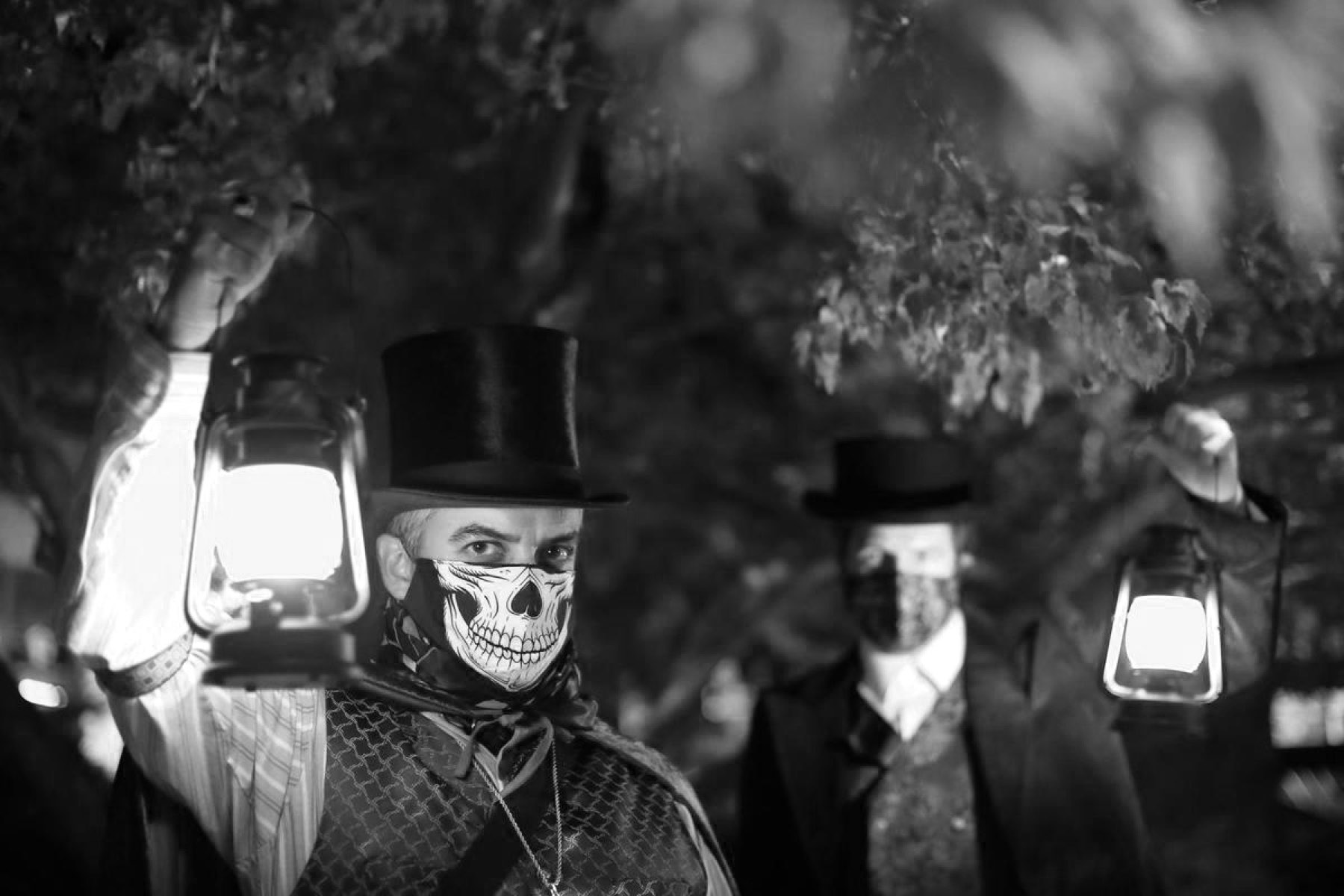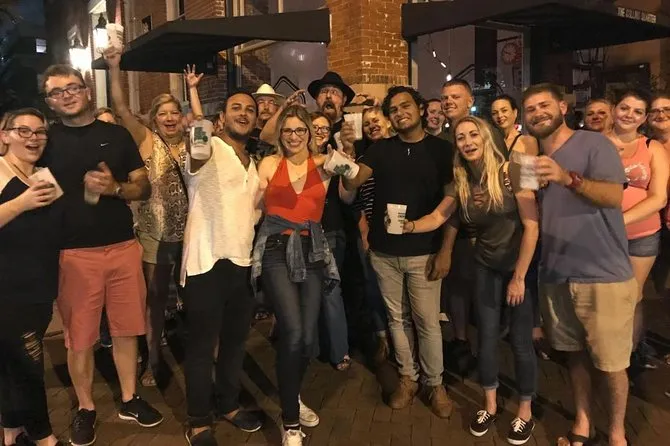
Spooky Savannah Haunted Bar Crawl is a two-hour guided walk through the Savannah historic district run by Spooky Savannah Ghost Tours, booking from $34.70 per person at our July 30, 2026 check. The adult age band on the listing starts at 21, one of only two of the twelve Savannah listings we checked that publish a 21-and-over adult band, and the cheaper of that pair. The route names two stops on foot, Colonial Park Cemetery and Wright Square, and flags Ellis Square and Factors Walk as pass-bys. The operator's own description adds three pubs it calls haunted, with a drink you can carry to the next stop. Groups run up to 30, cancellation was free at our check, and the listing marks the tour as not wheelchair accessible.
| Detail | What the listing shows |
|---|---|
| From price | $34.70 per person (checked July 30, 2026) |
| Duration | 2 hours |
| Departures | No clock time and no time of day verified for this listing. Confirm when you book. |
| Ages | Adult band 21 to 90, per the listing's own age bands. No child band. |
| Stops | Colonial Park Cemetery and Wright Square on foot; Ellis Square and Factors Walk flagged as pass-bys |
| Bars | Three pubs the operator calls haunted. None of them is named on the listing. |
| Group size | Up to 30 |
| Wheelchair access | Not accessible, per the listing. Most Savannah walking tours we compared are. |
| Meeting point | Not verified. Confirm the address when you book. |
| Cancellation | Free cancellation was flagged at our July 30, 2026 check. We did not capture the window, so read the terms. |
| Booking status | In stock at our July 30, 2026 check. Three of the twelve Savannah listings we checked were not. |
| Rating | 4.7 from 1,008 Viator reviews, seventh largest of the twelve Savannah samples we checked |
| Operator | Spooky Savannah Ghost Tours. We do not run this tour. |
What you will see
Colonial Park Cemetery anchors the walking half, roughly six acres between East Oglethorpe Avenue and East Perry Lane. The ground closed to burials on July 1, 1853 and took its last official interment on April 19, 1861, an eight year old named William Francois Joseph Thomasson; the city bought it for $6,500 in November 1895 and finished converting it to a public park by 1897 (Jefferson Hall). Union troops occupied Savannah on December 24, 1864, and several hundred of them camped in the burial ground and sheltered in its vaults (Colonial Park Cemetery). The documented scale is heavier than the legend: 13,345 registered Savannah deaths between 1803 and 1853, against fewer than 700 surviving headstones. Most of the people under that ground were never marked at all.
The stories sold here mostly do not survive the records. The mass grave of 700 yellow fever victims is not established: an 1887 survey of the stones made 1820 the most represented year at 49 headstones, and Hall concluded that more of that year's dead were probably buried in the separate 1819 cemetery, so the 1970 plaque overstates it. The variant that sets the figure at 666 has no source. Sherman's men did not do most of the damage either; the vandalism record runs across more than a century of local wear. There was no dueling ground on the south side, which was the City Pound, an animal impound lot established in April 1810. Button Gwinnett, a signer of the Declaration, is buried here, but the identification of his specific remains rests on a contested twentieth century exhumation. What is genuinely old is the ghost telling: Richard West Habersham, writing in the 1880s, recorded his own encounter in this cemetery (In Their Own Words).
Wright Square, on Bull Street between State and York, was laid out in 1733 as Percival Square and renamed about 1763 for James Wright, royal governor of Georgia from 1760 to 1782 (Georgia Historical Society). Its documented grave belongs to Tomochichi, the Yamacraw mico who negotiated the land agreement that let the colony exist. He died on October 5, 1739 and was buried at the center of the square on Oglethorpe's order, with a military funeral, at his own request to lie in the town he had helped create (Georgia Historical Society). The 1883 monument to William Washington Gordon is believed to stand over him, and on April 21, 1899 the Georgia Society of the Colonial Dames dedicated a Stone Mountain boulder in the southeast corner as a replacement memorial. Guides like to say a railroad company bulldozed his burial mound for that monument; the mound removed in 1883 was ornamental earthwork the city built in 1871 under Alderman John Oliver Ferrill (Jefferson Hall).
The square is also sold as the hanging square. Alice Riley, an Irish transported servant, was hanged on January 19 or 20, 1735 for the murder of her master William Wise, alongside a fellow servant named Richard White, and she was the first woman executed in Georgia. Most of what gets added to that is later invention: the site of Georgia's first capital execution is unknown, and neither the courthouse nor the log house stood in Percival Ward until 1736, a year after she died (Jefferson Hall). White was her co-defendant, and no record establishes a marriage. The thin Spanish moss blamed on her dying curse is maintenance: the city cleared moss from all eleven squares north of Oglethorpe Avenue. Ellis Square and Factors Walk close the itinerary as pass-bys, and our Savannah research covers neither, so we leave them undescribed. We found no named witness, dated incident or published investigation behind an apparition claim at any stop on this route, or at the three pubs, which the listing never names.
Who it suits
This is two hours on foot with three bar stops built into the route, and the age floor is real: the adult band starts at 21 and there is no child band. The listing marks the tour as not wheelchair accessible, worth knowing in a city where most of the walking tours we compared are marked accessible and the seated trolleys are not. Groups run up to 30, so expect a listening crowd.
- Skip it if anyone in your party is under 21. The adult band starts there.
- Skip it if you want the history without the drinking. Savannah has storytelling walks at similar prices.
- Skip it if you need step-free access or a seat. This listing is marked not wheelchair accessible.
- Confirm the meeting point and the departure time when you book. Neither is published.
- Expect the pubs to be a surprise. The operator claims three haunted ones and names none.
How it compares
Savannah gave us two pub crawls in the twelve listings we checked, and this is the cheaper and shorter of the pair. Haunted Savannah Booze and Boos Ghost Walking Tour, run by Nightly Spirits, is $39.92 for three hours, also 21 and over, rated 4.9 across 1,249 Viator reviews and capped at 16 rather than 30. Both are marked not wheelchair accessible, so the choice between them is length, price and group size rather than access.
If the drinking is not the point, the straight walks are the better comparison. Savannah History and Haunts Candlelit Ghost Walking Tour is $39 for 90 minutes and holds the best combination of rating and sample size in that set, 4.9 across 3,445 reviews, from age 13. Savannah's Ghost City Dead of Night Walking Night Tour is $34.99 for 90 minutes, names six stops including both of this route's walking stops, and is listed as wheelchair accessible. For the wider field, see Savannah ghost tours compared and the twelve spookiest Savannah ghost tours.
Questions people ask
How old do you have to be?
Twenty-one and over, from the listing's own adult age band of 21 to 90. There is no child band.
How long is it and what does it cost?
Two hours, from $34.70 per person at our July 30, 2026 check. Prices move, so confirm the current rate on the booking page.
Which stops does it name?
Two on foot, Colonial Park Cemetery and Wright Square, with Ellis Square and Factors Walk listed as pass-bys. Three pubs are promised and none is named.
Is it wheelchair accessible?
The listing says it is not. In Savannah that is worth checking: most of the walking tours we compared are marked accessible, while the seated trolleys are not.
Was Alice Riley hanged in Wright Square?
Probably not. She was executed in January 1735, but neither the courthouse nor the log house stood in that ward until 1736, and the site of Georgia's first capital execution is not recorded.
Is there a mass grave of 700 yellow fever victims in Colonial Park Cemetery?
Not on the evidence. An 1887 survey of the stones made 1820 the most represented year at 49 headstones, and the research suggests more of that year's dead lie in the separate 1819 cemetery.