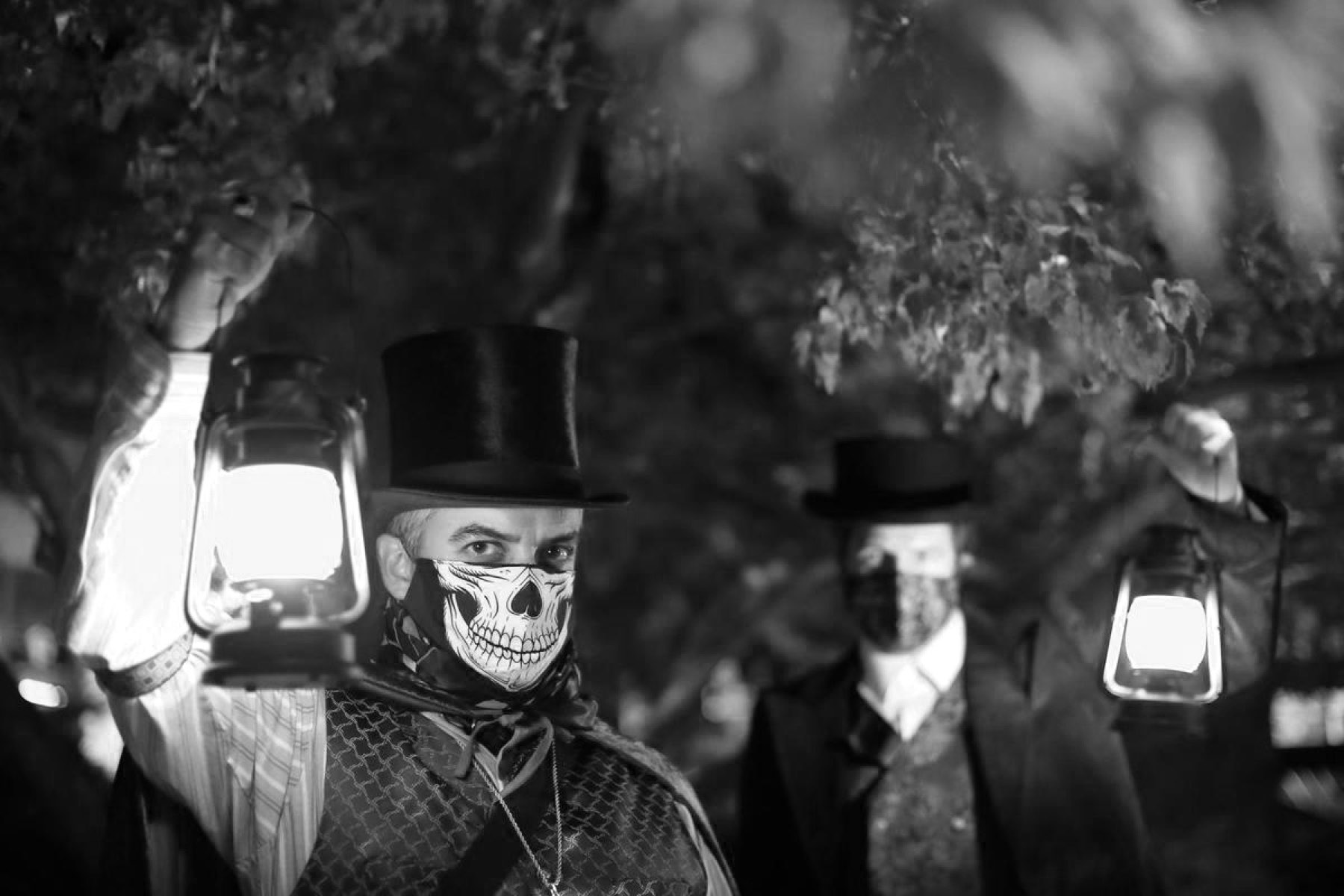
Genteel and Bard's Savannah Dark History and Ghost Encounter Walking Tour is an evening walk of one hour fifty minutes through the Savannah historic district, run by Genteel and Bard, from $35 per person at our July 30, 2026 check. It publishes seven stops, the longest stop list of the twelve Savannah ghost listings we checked: Oglethorpe Square, Wright Square, the Juliette Gordon Low Birthplace, Chippewa Square, the Sorrel-Weed House, Madison Square and Colonial Park Cemetery. Groups cap at 22, the listing states wheelchair and stroller access, and the adult age band starts at 13 with a child band from 8. It was the only Savannah listing in that check flagged as likely to sell out.
| Detail | What the listing shows |
|---|---|
| From price | $35 per person (checked July 30, 2026) |
| Duration | 1 hour 50 minutes |
| When it runs | Evening. No clock time verified. |
| Availability | In stock July 30, 2026, flagged likely to sell out |
| Ages | Adult band starts at 13; child band 8 to 12, discounted |
| Group size | Maximum 22 |
| Accessibility | Wheelchair and stroller accessible, per the listing |
| Meeting point | Not verified. Confirm when you book. |
| Cancellation | Free, per the listing, up to 24 hours |
| Rating | 4.8 from 1,700 Viator reviews (fourth-largest of the twelve Savannah listings we checked) |
| Operator | Genteel and Bard. We do not run this tour. |
What you will see
The Sorrel-Weed House at 6 West Harris Street, on the north side of Madison Square, carries Savannah's best known ghost story, and the paperwork breaks it. Built in 1840 for the shipping merchant Francis Sorrel, it became one of the first two Georgia State Landmarks in 1954 (Georgia Historical Society). Most tours have Matilda Sorrel throwing herself from an upper window of this house after finding her husband with an enslaved woman called Molly. Sorrel had sold the house to Henry D. Weed in June 1859 for $23,000 and moved next door to 12 West Harris Street; Matilda died in March 1860, next door, nine months later (Savannah First-Timer's Guide). No document names a Molly in that household or records her death, and James Caskey, a working Savannah ghost-tour author, published the debunking of the house's story himself. Two more corrections belong to the square. Sherman worked from the Green-Meldrim House on its west side from December 22, 1864 to February 1, 1865 (Green-Meldrim House), not from the Marshall House. Sergeant William Jasper was mortally wounded near here on October 9, 1779; his famous flag rescue was at Fort Sullivan near Charleston in 1776 (Georgia Historical Society).
Wright Square, laid out in 1733 as Percival Square and renamed about 1763 for the royal governor James Wright, is sold as the hanging square (Georgia Historical Society). Alice Riley, an Irish transported servant, was hanged in January 1735 for the murder of her master William Wise, the first woman executed in Georgia. Where it happened is not recorded: Jefferson Hall concluded that "the location of Georgia's first capital execution is unknown", and no courthouse stood in Percival Ward until 1736, a year after she died (Jefferson Hall). The thin Spanish moss blamed on her dying curse is maintenance: the City cleared moss from all eleven squares north of Oglethorpe Avenue. The square's documented grave is Tomochichi's: the Yamacraw mico died on October 5, 1739 and was buried at its center by Oglethorpe's order, with a military funeral, at his own request (Georgia Historical Society). The mound the railroad cleared in 1883 was not his grave marker; the city built it in 1871 as ornament (Hall on the mounds).
Colonial Park Cemetery closed to burials on July 1, 1853 and took its last interment on April 19, 1861; the city bought the ground for $6,500 in November 1895 and made it a park (Jefferson Hall). Union troops occupied Savannah on December 24, 1864, and several hundred camped in the ground and sheltered in its vaults (Colonial Park Cemetery). The mass grave of 700 yellow fever victims sold here is not established: an 1887 survey of the stones made 1820 the most represented year at 49 headstones, and Hall puts more of that year's dead in the separate 1819 cemetery. The version that sets the figure at 666 has no source, and the dueling ground on the south side was the City Pound, an animal impound lot from April 1810. The documented scale is bleaker: 13,345 registered Savannah deaths from 1803 to 1853, against fewer than 700 surviving headstones.
Chippewa Square dates from 1815, eighty years too late for the 1735 hanging some guides relocate here, and its Oglethorpe Monument of 1910 stands in Chippewa rather than in Oglethorpe Square (James Oglethorpe Monument); the Forrest Gump bench was a prop, now at the Savannah History Museum. The Juliette Gordon Low Birthplace of 1821 is where Juliette was born on October 31, 1860 and lived through the Civil War with her family and with the people the household enslaved, as the museum's own history states (Juliette Gordon Low Birthplace). On Oglethorpe Square, the 1819 Owens-Thomas House and Slave Quarters keeps the original haint blue ceiling paint in its quarters (Telfair Museums), a belief recorded among enslaved people and in Gullah Geechee tradition.
Who it suits
One hour fifty minutes on foot, capped at 22, with wheelchair and stroller access per the listing. That matters in Savannah, where the seated options are the ones that are not accessible. The adult band starts at 13 and a child band covers 8 to 12, which rules out toddlers.
- Skip it if you want equipment and a hunt. This is storytelling on foot.
- Skip it if you need a seat. The seated Savannah options are trolleys, listed as not wheelchair accessible.
- Skip it if the material is wrong for your group: an execution, a burial ground, houses whose households enslaved people.
- Confirm the meeting point and departure time when you book. Neither is published.
- Book ahead on fixed dates: it was the only Savannah listing in our check flagged likely to sell out.
How it compares
The splits that matter are stops, access and length. Savannah History and Haunts Candlelit Ghost Walking Tour carries the largest review count of the twelve Savannah listings we checked, 4.9 across 3,445, at $39 for 90 minutes, but publishes no itinerary. Savannah's Ghost City Dead of Night Walking Night Tour is $34.99 for 90 minutes and names six stops, overlapping here at Colonial Park Cemetery, the Sorrel-Weed House and Wright Square, with a minimum age of 16 and groups up to 30.
Savannah Ghosts and Gravestones Trolley Tour is the seated alternative at $42.80 for 75 minutes, and it is where the accessibility assumption reverses: it is listed as not wheelchair accessible while this walk is. The case for Genteel and Bard is the published seven-stop route, the cap of 22 and the child band from 8. For the wider field, see Savannah ghost tours compared and the twelve spookiest Savannah ghost tours.
Questions people ask
How long is it and what does it cost?
One hour and fifty minutes, from $35 per person at our July 30, 2026 check. Prices move, so confirm the rate before booking.
Which stops does it name?
Seven: Oglethorpe Square, Wright Square, the Juliette Gordon Low Birthplace, Chippewa Square, the Sorrel-Weed House, Madison Square and Colonial Park Cemetery. The operator's description names one more, 12 Oglethorpe.
Can children come?
The adult band starts at 13 and a child band runs 8 to 12 at discounted rates. The listing we checked shows no band below age 8.
Is it wheelchair accessible?
The listing says yes, and lists stroller access too. Savannah's trolley ghost tours are listed as not accessible, so do not assume the seated ride is easier.
Did Matilda Sorrel die in the Sorrel-Weed House?
No. Francis Sorrel sold that house in June 1859 and moved next door to 12 West Harris Street; she died in March 1860. Most tours still tell it the other way.