Tucson's oldest neighborhood, wall by wall
Barrio Viejo sits a ten minute walk south of downtown Tucson, and it does not look like anywhere else in Arizona. Sonoran adobe rowhouses come right up to the sidewalk, shoulder to shoulder, thick walls washed in ochre, cobalt, mint, and rose. Families began building here in the mid-1800s, and the neighborhood has carried Mexican, Chinese, and African American histories in its bricks ever since. The name means, simply, the old neighborhood, and locals say it with the weight those words deserve.
The art here is quieter than a gallery district's and better for it. Murals honor the families who built the homes they are painted on. Window bars bend into animals. Old store signs surface through layers of paint. This page maps the walk we recommend: about 1.2 miles, fifteen stops, with the artist named at every wall where we could verify one. Where we could not, we say so rather than guess.
How to walk this map
The loop runs about 1.2 miles and takes 60 to 90 minutes at photo pace, flat the whole way. Start at El Tiradito on South Main Avenue, work over to the Meyer and Simpson corner, go north for Teatro Carmen and the ironwork, come back south down Meyer's 500 and 600 blocks, jog east on Simpson for the Convent Avenue corners, then finish west past Ninth Avenue to La Suprema and El Parque de San Cosme. Every stop below carries a street address, so any mapping app can string the sequence together.
Two things to know before you set out: this is a living residential neighborhood, so read the etiquette notes further down, and several of the murals are on private homes that you view from the public sidewalk. The addresses tell you where to stand, not where to wander.
The walking route, stop by stop
Fifteen stops, in walking order. Artist credits appear wherever we could confirm them against published reporting; unsigned and unrecorded work is described without a guess.
Stop 1: El Tiradito Wishing Shrine, 420 S. Main Ave.
Begin at the small open-air shrine locals call El Tiradito, an adobe alcove blackened by decades of candle smoke, with folded paper wishes tucked into the wall. The shrine has stood on this donated plot since 1927, and in 1971 it became the first Arizona property listed on the National Register of Historic Places for its traditional cultural value. That listing helped stop a planned crosstown freeway, which is a large part of why the neighborhood around you still exists. We keep a fuller history on our El Tiradito page, and the legends attached to the shrine get their own telling in The Spirits of Barrio Viejo. Leave every candle, note, and offering exactly as you found it.
Stop 2: the La Pilita mural by Martín Moreno, 420 S. Main Ave.
Steps away, on the south wall of the small building beside the shrine, longtime home of the La Pilita cultural center, is the walk's oldest mural story. Martín Moreno first painted this wall in the 1980s with young people from the neighborhood, and after the building was restored he returned and repainted it himself in 2011. A wall made with neighborhood kids, then remade by the same artist a generation later: that is the barrio's whole relationship with its art, condensed.
Stop 3: the Cuauhtémoc statue at Meyer and Simpson
Walk east to the corner of South Meyer Avenue and West Simpson Street, where a bronze figure of Cuauhtémoc, the last Aztec emperor, stands with arms and regalia reaching out from the pedestal. It is the work of Luis Gustavo Mena, a Tucson artist whose murals you will meet again at the end of this walk. A short wall painted with cacti and desert blooms sits near the same corner; we have not confirmed that artist, so we will not guess. If you know whose work it is, write to us and we will credit them.
Stop 4: the Lash Factor studio mural by J. Keegan Rider, Simpson and Meyer
On the southeast corner of the same intersection, a small commissioned mural by J. Keegan Rider brightens the wall of the corner studio. Rider has said he wanted to add more beauty and art to the historic neighborhood, and the piece sits politely in scale with the rowhouses around it, which is its own kind of respect.
Stop 5: Teatro Carmen, 380 S. Meyer Ave.
Half a block north stands the Sonoran mission style facade of Teatro Carmen. Carmen Soto Vásquez built the theater and opened it on May 20, 1915, and for roughly a decade it was Tucson's leading stage for Spanish-language drama, drawing companies from Mexico and Spain. The building later lived as a movie house, a boxing arena, and an Elks lodge, and a restoration effort has been working since 2021 to return it to performance use. Cross the street for the full view of the arched front.
Stop 6: the ironwork of Meyer Avenue, 363 and 369 S. Meyer Ave.
The barrio's art is not all paint. At 369 South Meyer a metal owl keeps watch from a gate, and at 363 the window bars bend into the shape of a rabbit. The makers went unrecorded, as porch-level craft here usually did. Enjoy both from the sidewalk; they guard private homes.
Stop 7: Las Cuatro Esquinas ghost signs, Simpson and Convent
Walk back south on Meyer to Simpson, then one short block east. The northeast corner of Simpson Street and Convent Avenue wears restored painted signage from the building's days as a corner grocery, the hand-lettered inventory of a store that fed the neighborhood. Signs like these are called ghost signs, advertising that outlives its business, and the barrio keeps some of the best in the city visible rather than painting over them.
Stop 8: Peggy Sue by Danny Martin, seen from 25 W. Simpson St.
Continue east along Simpson toward Stone Avenue. The sidewalk at 25 West Simpson Street is the best public vantage point for Peggy Sue, Danny Martin's portrait in the skeletal, Day of the Dead inspired style he has carried across dozens of Tucson walls. The mural itself is on a private residence around the corner, so take the view from here and leave the household its privacy.
Stop 9: Joe Pagac's tribute to the Herrera family, 25 W. Simpson St.
The same address holds a second piece. Joe Pagac, whose walls appear all over Tucson, painted a tribute mural here honoring Andres and Guadalupe Herrera, the couple who built this home in 1906. Most mural districts celebrate celebrities; Barrio Viejo commissions portraits of its original homeowners. That difference is the neighborhood in miniature.
Stop 10: the carved bricks at Convent and Kennedy
Loop back west and take Convent Avenue south to Kennedy Street. The home on the southwest corner carries names and declarations of love carved directly into its brick, initials layered over each other across generations. Read them, photograph them, and do not add your own.
Stop 11: ghost signs and the Guerrero boyhood home, 508 and 505 S. Meyer Ave.
Back on Meyer, renovation at number 508 peeled paint back to signs from the building's earlier lives, including vintage root beer lettering and signage from the La Costa del Pacifico bakery. Across the street at 505 stands the restored boyhood home of Lalo Guerrero, the Tucson-born songwriter often called the father of Chicano music, who grew up in these blocks.
Stop 12: the Lalo Guerrero mural by Johanna Martinez, 600 S. Meyer Ave.
Just down the street, the building that opened in 1912 as Lee Ho's general store, now offices, carries Johanna Martinez's 2009 mural celebrating Guerrero. Store, song, and wall sit within a block of the house he grew up in. The barrio raised him, and the wall remembers him.
Stop 13: the monsoon mural by Jessica Gonzales, 592 S. Ninth Ave.
Head west past Main to South Ninth Avenue, a narrow street that dead-ends in the quietest corner of the walk. On the wall of a private home at 592, Jessica Gonzales painted a monsoon rolling in, the storm color this desert waits for all summer. Keep voices low here and take the view from the public side of the street.
Stop 14: the La Suprema community mural, designed by Isaac Caruso, 319 W. Simpson St.
At 319 West Simpson Street, the renovated La Suprema building, a tortilla factory for much of its life and a neighborhood market before that, now houses a workspace and events hall. Isaac Caruso designed the mural on its north wall from the barrio's own history, and neighbors helped paint it section by section before the building reopened. It reads as the neighborhood's memory of itself, painted by the people doing the remembering.
Stop 15: the El Parque de San Cosme mural by Luis Gustavo Mena, W. Simpson St. at the park
Finish at El Parque de San Cosme, the pocket park along West Simpson near the freeway edge of the barrio, where Luis Gustavo Mena's wraparound mural depicts barrio residents past and present. After fifteen stops of walls made by and for this neighborhood, it is the right closing image: Barrio Viejo painting its own portrait.
Visiting etiquette: this is a living neighborhood
Barrio Viejo is not an outdoor museum. People cook, sleep, garden, and grieve behind these walls, and several of the murals on this map are on private homes. Photograph from the public sidewalk, stay out of yards and doorways, and skip the close-up through anyone's window or gate. The adobe itself is old and soft, so do not lean on walls or touch the painted surfaces; skin oils and backpacks do slow damage.
Keep conversation at porch volume, especially on the narrow dead-end streets, and never block a driveway while lining up a shot. At El Tiradito, the candles and notes are acts of devotion, not props; look as long as you like and move nothing. Pack out whatever you bring in. The neighborhood has welcomed respectful walkers for decades, and the murals exist because that welcome has been honored.
Parking, timing, and the light
Street parking inside the barrio is limited and several blocks are marked permit-only, so read every sign. Day visitors usually do best along South Main Avenue near the shrine, in the stretch fronting the school at 440 S. Main Ave., which is easiest on weekends. If downtown, you can also park once near the Tucson Convention Center and walk in; nothing on the loop is more than a few blocks from its edge.
For photographs, come in the first hour or two after sunrise or the last before sunset, when the low sun sets the adobe glowing and the mural color goes rich instead of chalky. Midday flattens everything, and from May through September the heat is the real constraint: walk early, carry water, and give the afternoon to shade. Morning also happens to be the politest hour to move through a residential street with a camera.
Elsewhere in Tucson: the downtown mural mile
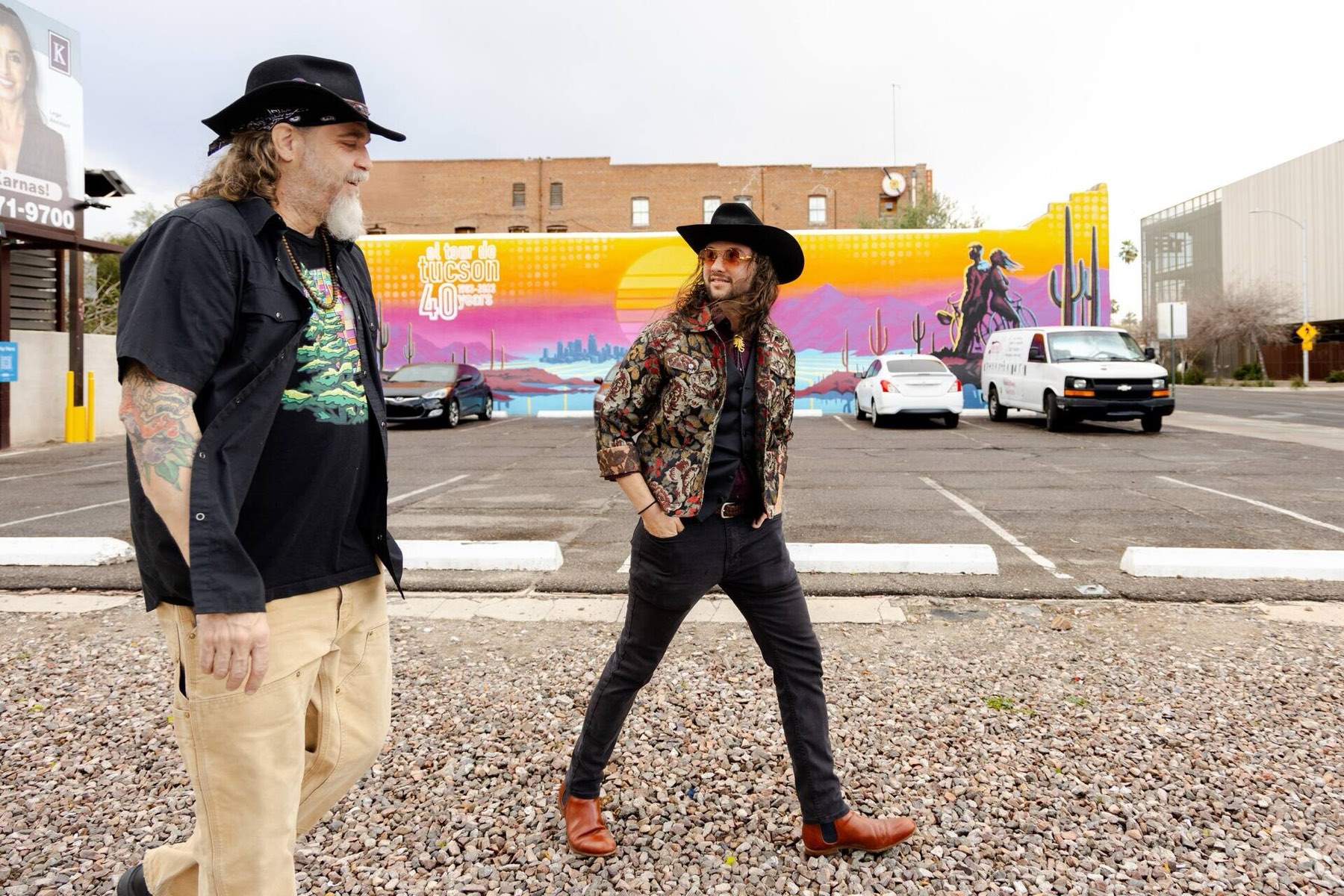
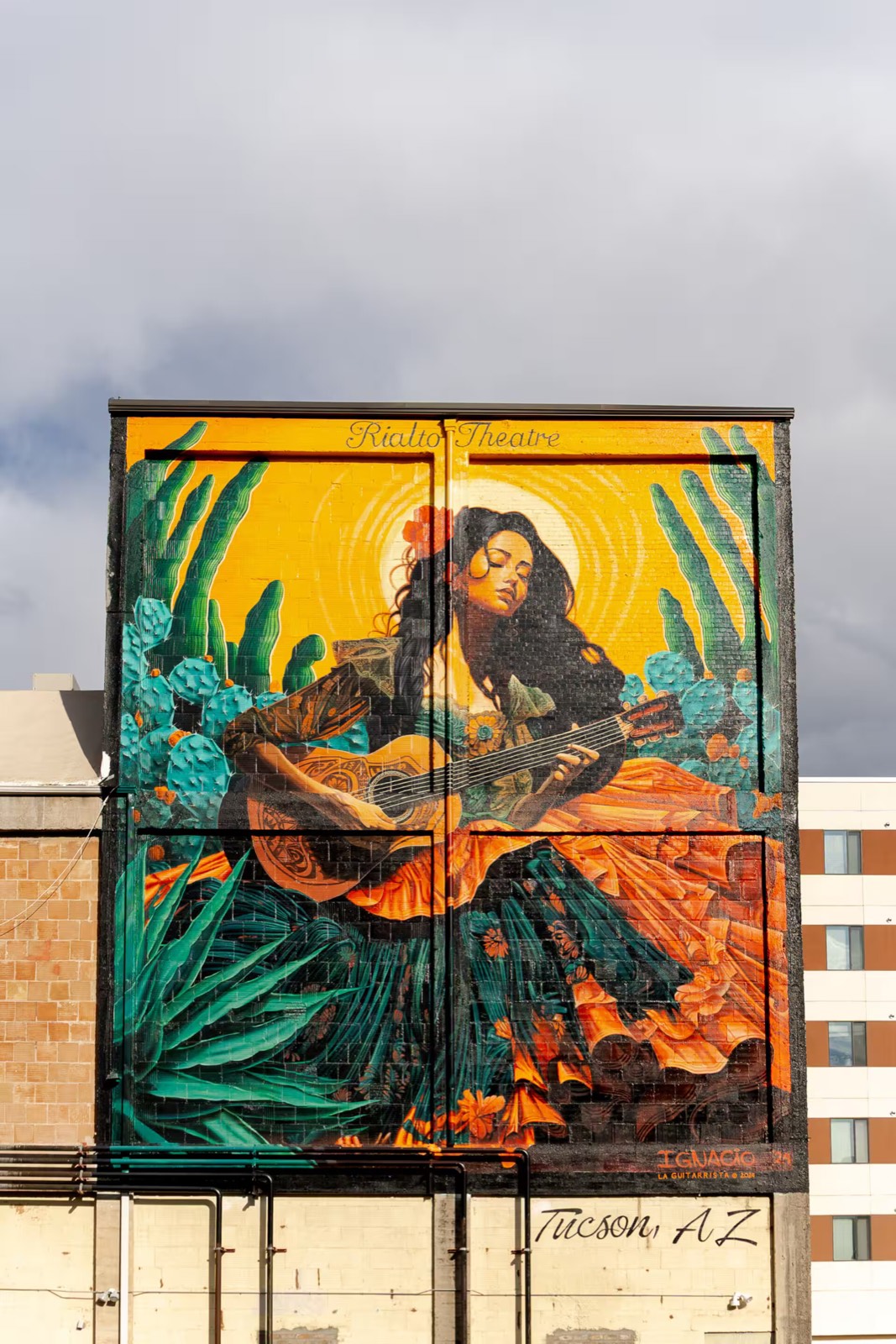
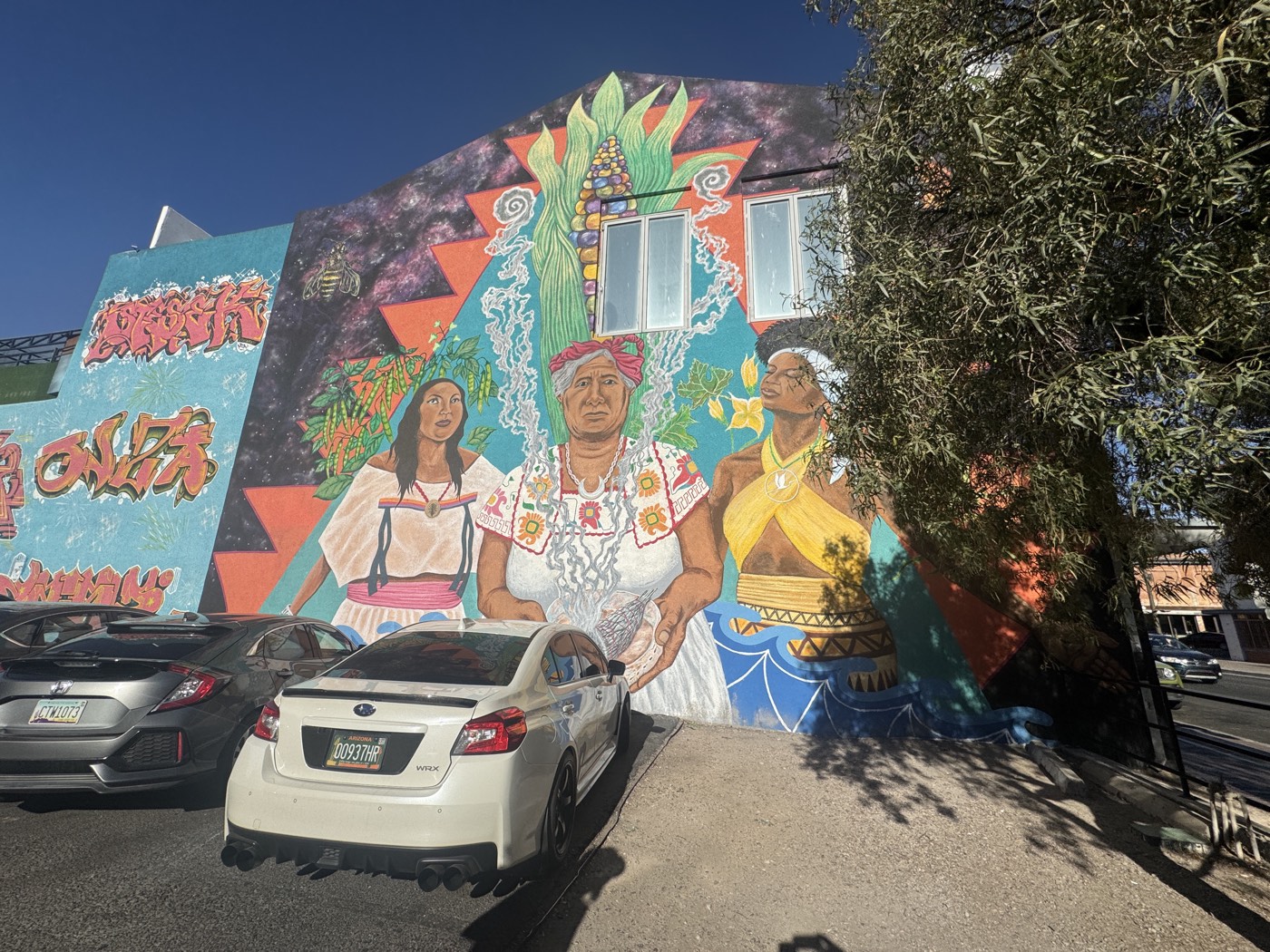
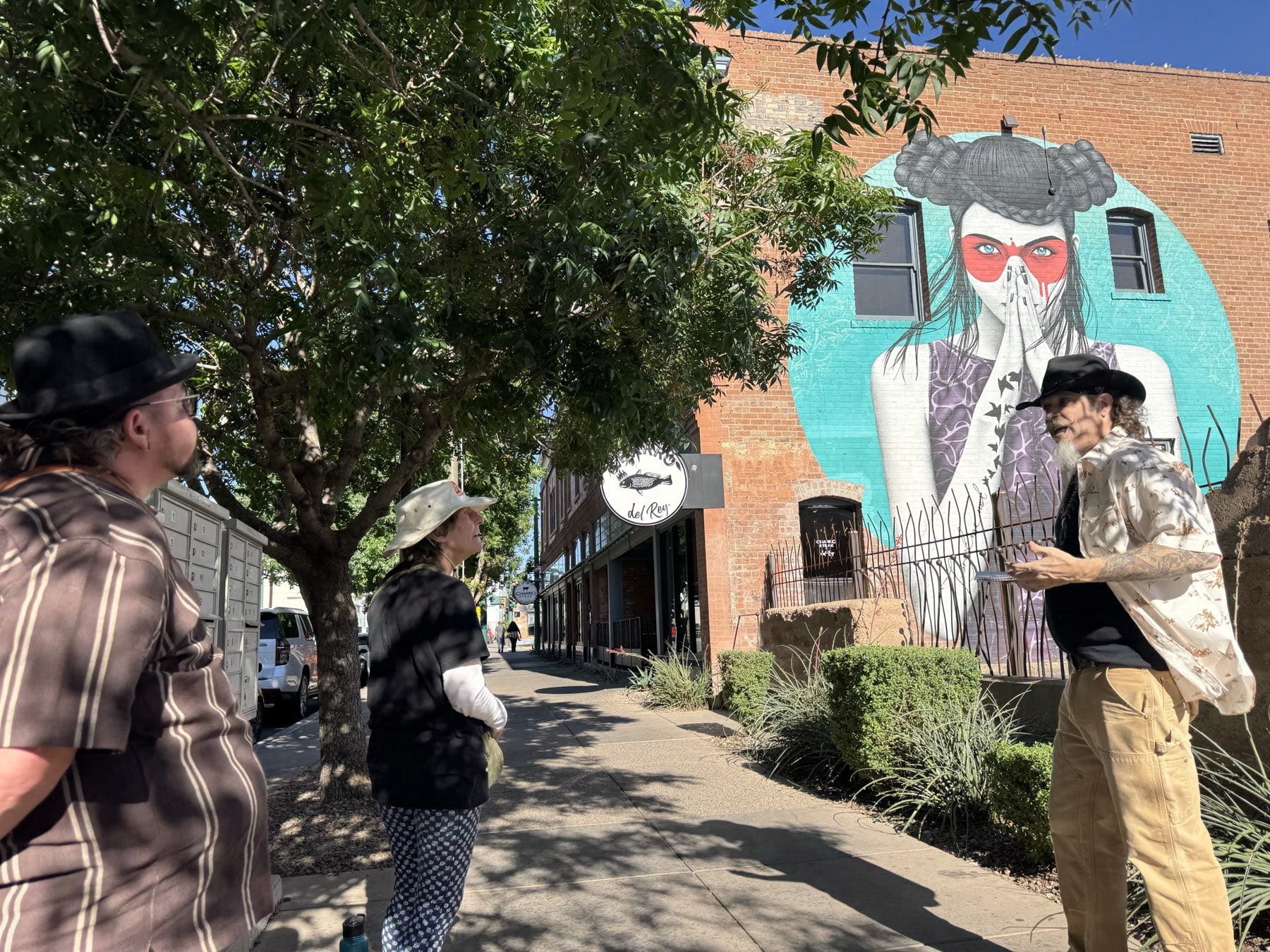
Barrio Viejo holds Tucson's most personal murals, but the city's densest run of big walls is downtown, a 15 minute walk north. The alley off Toole Avenue carries Ignacio Garcia's towering Rialto Theatre mural, Congress Street has Las Tres Hermanas, painted by a team led by Ruben Urrea Moreno with Melo Dominguez, Antonio Lucero, and Gerardo Frias, Broadway holds Fin DAC's Vergiss, and Joe Pagac's El Tour de Tucson mural celebrates the city's signature ride. We walk that gallery, artists named at every wall, on our Mural Tour of Downtown Tucson, which runs on select dates.
If you are building out a full day, our guide to things to do in Tucson covers the museums, parks, and markets that pair well with a morning in the barrio. If you would rather have the day already sequenced, 24 hours in Tucson gives the barrio the golden-hour slot.
Questions people ask
Who painted the Greetings from Tucson mural?
Victor Ving and Lisa Beggs of the traveling Greetings Tour created the postcard-style Greetings from Tucson mural in February 2017 on the back of the Miller's Surplus building at 406 N. Sixth Ave., and Tucson artist Rock Martinez added the skeleton woman inside the letter C. It sits about a mile and a half north of Barrio Viejo, so it is not a stop on this walk; catch it on a downtown mural outing instead.
How many murals are in Tucson?
There is no official count, and published numbers disagree. The Arizona Daily Star's public mural map has documented more than 100 murals around the city, while local photographer BG Boyd's Tucson murals database catalogs more than 500. Hundreds is the honest answer, and new walls go up every year.
Is Barrio Viejo safe to walk?
Barrio Viejo is a quiet residential historic district a short walk south of downtown, and this loop follows public sidewalks the whole way. Treat it like any city neighborhood: daylight hours are best for both courtesy and photographs, some sidewalk stretches are uneven, and in summer the heat is the thing to plan around. Go early and carry water.
Can you visit El Tiradito?
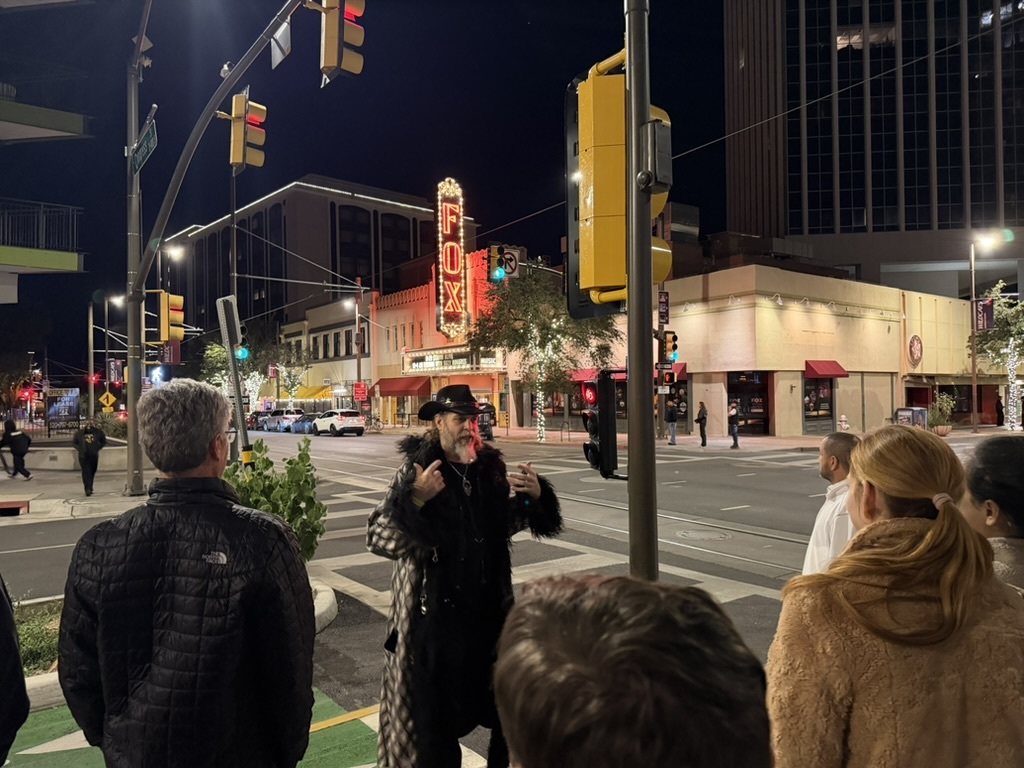
Yes. The shrine stands in the open at 420 S. Main Ave. and is free to visit. It remains an active place of devotion, so look as long as you like but leave candles, notes, and offerings untouched. Our Downtown Tucson Haunted History Tour includes it as a stop if you would rather hear its story told in person.
Walk Tucson with a local guide
If this map whets the appetite, two of our small-group walks pick up where it leaves off. The Downtown Tucson Haunted History Tour is booking now: 90 minutes and about a mile through downtown, departing from Hotel Congress with nightly departures at 8 PM, $29 for adults, $25 for students, and $22 for children, and El Tiradito is one of its stops. The Mural Tour of Downtown Tucson runs on select dates; check the calendar for the next opening. Company-wide: 30,000+ guests guided, guiding since 2015 across three Arizona cities.