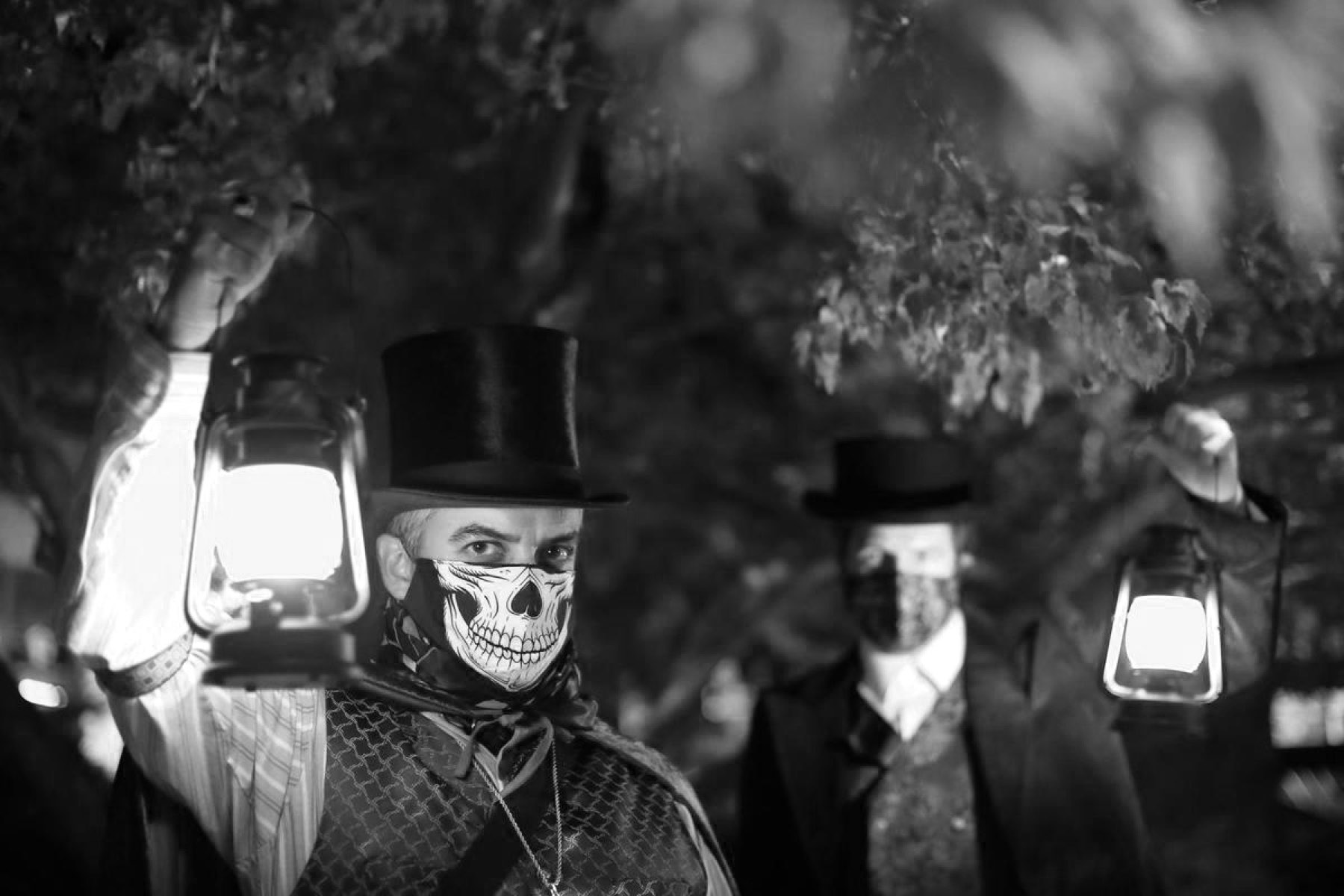
This is a 1 hour 45 minute night walk through the French Quarter, run by Witches Brew Tours and booking from $36.99 per person at our July 30, 2026 check. Its 4.5 rating rests on 13,610 Viator reviews, the largest review count among the fifteen New Orleans ghost listings we compared. The route names seven places and works ghost, voodoo and vampire material into one pass: the New Orleans Pharmacy Museum, Jackson Square and Lafitte's Blacksmith Shop Bar on foot, with pass-bys at the Old Ursuline Convent Museum, the LaLaurie Mansion and Voodoo Authentica. It runs at night, in all weather, and the listing says it is not wheelchair accessible, citing French Quarter terrain. It suits travelers who want all three themes in one walk rather than a single-subject tour.
| Detail | What the listing shows |
|---|---|
| From price | $36.99 per person (checked July 30, 2026) |
| Duration | 1 hour 45 minutes |
| When it runs | Night. No clock departure time verified. |
| Ages | Adult band starts at 13; youth 6 to 12, senior 60 and over, and infant 0 to 5 also sold |
| Wheelchair access | Not accessible, per the listing, which cites French Quarter terrain |
| Weather | Runs in all weather |
| Group size | No maximum verified |
| Meeting point | Not verified. Confirm the address when you book. |
| Cancellation | Free cancellation to 24 hours before the start, at our July 28, 2026 check |
| Rating | 4.5 from 13,610 Viator reviews, the largest sample of the fifteen we compared |
| Operator | Witches Brew Tours. We do not run this tour. |
What you will see
At the New Orleans Pharmacy Museum, 514 Chartres Street, the tour trade's story and the building's own record part company. Louisiana's 1804 law made pharmacists sit a licensing examination, the first such requirement in the country, and Louis J. Dufilho, Jr. passed his three-hour oral exam before the medical board at the Cabildo on May 11, 1816, becoming the first licensed pharmacist in the United States. The Creole townhouse was built for him in 1822 and 1823, and he opened the ground-floor shop in 1823 (the museum). That is not the same as the first pharmacy in America, a line you will hear on this sidewalk. The ghost story here says Dr. James Dupas, who bought the business in 1855, experimented on pregnant enslaved women and still walks the building. The museum that occupies the address says in its own FAQ that there is no evidence of poisonings or medical experiments on enslaved or otherwise unwilling people there, and it reads the tale as a transplanted version of J. Marion Sims, whose documented non-consensual operations on enslaved women took place in Montgomery, Alabama. Tours stop outside; the museum charges admission.
Jackson Square was laid out in August 1721 as the Place d'Armes, the colonial capital's parade ground flanked by two L-shaped soldiers' barracks, and the Historic New Orleans Collection states that public punishments and executions were carried out there. It has carried Andrew Jackson's name only since January 1851, after the Baroness Micaela Almonester de Pontalba spent more than $300,000 on the red-brick rows that flank it; Clark Mills's equestrian statue was unveiled in February 1856. Now the correction. Guides routinely say the heads of the men who led the 1811 German Coast uprising were displayed on pikes in this square. The record puts that display along the river road and at the city gates, not on the Place d'Armes, and it was state terror rather than set dressing. No source gives a number of people executed here, so any count you hear is invention.
The Old Ursuline Convent Museum at 1100 Chartres Street is the vampire stop, and the dates dismantle the story. Twelve Ursuline nuns arrived from Rouen in 1727, and the young Frenchwomen known as filles a la cassette, sent to the colony with small trunks of clothing to marry colonists, arrived around 1728. The building tour groups look at was not finished until 1752 (64 Parishes), twenty-four years later, so whatever the trunks held was never sealed on that third floor. Cassette means a small chest, roughly hand luggage; the English word casket narrowed to mean coffin much later, which makes the vampire reading wordplay rather than evidence. As for shutters nailed shut with papal-blessed nails, no pope set foot in New Orleans before John Paul II in 1987. The quieter truth is that this building came through the fires of 1788 and 1794 and is the oldest surviving building in the French Quarter.
The LaLaurie Mansion at 1140 Royal Street is a crime record, and private property you see only from the pavement. A kitchen fire on April 10, 1834 brought responders into locked quarters where enslaved people were confined; the New Orleans Bee reported the next morning that seven of them were found mutilated, and a crowd then gutted the house (the Vieux Carre Digital Survey, 64 Parishes). Two corrections matter. The catalogue of surgical horrors most tours recite traces to Jeanne deLavigne's Ghost Stories of Old New Orleans of 1946, which cited no sources and whose details appear nowhere in the 1834 papers. And the house is not the house: Pierre E. Trastour bought the ruin on March 24, 1837 and rebuilt it, so the facade you photograph postdates the crime. Lafitte's Blacksmith Shop Bar at 941 Bourbon Street carries a third invention. The property chain from 1773 to 1833 belongs to the family of a carpenter, Bartholomie Robert, with no Lafitte in it, and Jean Lafitte, born around 1780, did not reach the Gulf before about 1804 (nola.com). The earliest printed link is Lafcadio Hearn's phrasing in 1883. Nothing documents a smithy on the site, the bar dates only to the mid-1940s, and the oldest-bar-in-America line is marketing. What is real is the fabric: a brick-between-posts Spanish colonial house, most likely 1770s, on Bourbon Street.
Who it suits
This is one hour forty-five minutes on foot at night across three subjects, which makes it a first ghost tour rather than a deep dive into any one of them. The listing says it is not wheelchair accessible and points at French Quarter terrain.
- Skip it if you need step-free ground. Seven of the ten New Orleans tours in our city comparison do list wheelchair access.
- Skip it if you want one subject done properly. A single-theme walk will go further than a three-theme sampler.
- Youth bands from age 6 are sold, but the route includes the site of a documented 1834 atrocity, so judge the subject matter for your party.
- Confirm the meeting point when you book. We verified no street address and no clock departure time for this listing.
How it compares
Three siblings are the real alternatives. The Ghosts of New Orleans Tour is $29.99 for 90 minutes and caps at nine travelers, the smallest group cap we recorded for any New Orleans listing in the set, with the wheelchair and stroller access this walk does not offer. New Orleans Yellow Fever Ghost Tour is $35 for 90 minutes and holds 4.9 from 1,426 reviews, the highest rating in that comparison set, though it is also not wheelchair accessible. New Orleans Haunted History Ghost Tour is $30 for two hours, rated 4.6 from 2,274 reviews and capped at 28 with wheelchair and stroller access, and it overlaps this route at the LaLaurie Mansion, Lafitte's and Jackson Square.
The trade is feedback volume against rating and access. This walk's 13,610 reviews are nearly double the next-largest count in that set, so the sample behind its score is deep, but 4.5 is the lowest rating band there, shared with four other listings. For the wider field, see New Orleans ghost tours compared and our guide to the best haunted tours in New Orleans.
Questions people ask
How long is it and what does it cost?
One hour forty-five minutes, from $36.99 per person at our July 30, 2026 check. Confirm the current rate on the booking page.
Is it wheelchair accessible?
No, and the listing cites French Quarter terrain. Seven of the ten New Orleans tours in our city comparison do list wheelchair access.
Which places does it name?
The French Quarter, the New Orleans Pharmacy Museum, Jackson Square and Lafitte's Blacksmith Shop Bar, with pass-bys at the Old Ursuline Convent Museum, the LaLaurie Mansion and Voodoo Authentica.
Do you go inside the LaLaurie Mansion?
No. It is private, and the listing marks it as a pass-by. The house you photograph is Trastour's rebuild from 1837, not the 1834 one.
Were there really vampires at the Ursuline convent?
No document supports it. The women with the small trunks arrived around 1728, and the building was not finished until 1752.
Can I cancel?
The listing carried free cancellation to 24 hours before the start at our July 28, 2026 check. Read the terms on the booking page before you book.