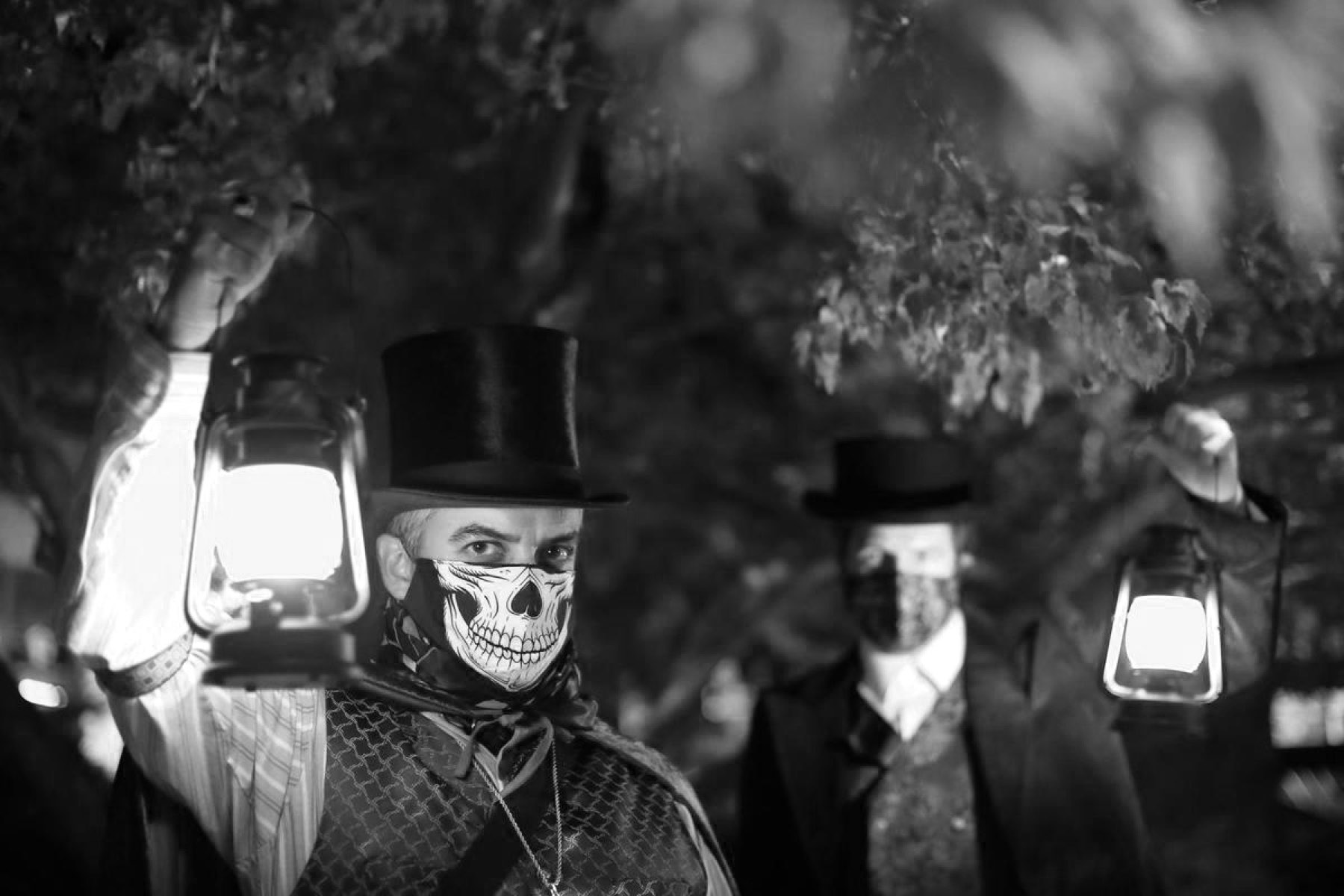
Haunted Ghosts and The Chicago Outfit Segway Tour is a two-hour night ride run by Absolutely Chicago Segway Tours, booking from $75.48 per person at our July 30, 2026 check. A costumed local guide leads a small group past landmark buildings lit up after dark and tells the stories behind the city's worst crimes and disasters, with the Chicago Outfit named in the listing's own title. The fit rules are strict, and they are the first thing to read: riders must weigh at least 100 pounds, the maximum recommended weight is 260 pounds, the minimum age is 12, and the listing is not wheelchair accessible. A Segway orientation is included, so no riding experience is assumed. It suits older teens and adults who are steady on their feet and would rather glide than walk.
| Detail | What the listing shows |
|---|---|
| From price | $75.48 per person (checked July 30, 2026) |
| Duration | 2 hours |
| When it runs | Evening, after dark. No clock time verified. |
| Minimum age | 12, per the listing's own adult age band |
| Weight limits | Minimum 100 pounds. Maximum recommended 260 pounds. |
| Riding experience | None assumed. A Segway orientation is included. |
| Wheelchair access | Not wheelchair accessible, per the listing |
| Group size | Small group, per the listing name we recorded July 29, 2026. No cap verified. |
| Route | The listing publishes no stop list, so we do not print one. |
| Cancellation | Not captured at our check. Read the cancellation terms on the booking page. |
| Availability | Bookable and flagged likely to sell out at our July 30, 2026 check |
| Rating | 4.7 from 38 Viator reviews, a thin sample |
| Operator | Absolutely Chicago Segway Tours. We do not run this tour. |
What you will see
The listing promises the after-dark version of downtown, landmark buildings lit up and covered at riding pace, with the narration doing the work. What it does not publish is a stop list, so we do not print a route, and you should ask the operator whether the ride passes a particular site if that site is why you are booking. The two subjects it does name are the Chicago Outfit and the city's worst crimes and disasters, so here is what the record says about them, including the parts most Chicago ghost narration gets wrong.
The Outfit's defining event is the St. Valentine's Day Massacre. On the morning of February 14, 1929, at about 10:30, seven men were shot dead inside the S.M.C. Cartage Company garage at 2122 North Clark Street. Four men arrived, two in police uniform, which is why seven armed men lined up against a wall without a fight, and two of the dead were not gunmen: Reinhardt Schwimmer, 29, an optician who liked the company, and John May, 35, an occasional mechanic (stvalentinemassacre.org; the Chicago Tribune of February 15, 1929). Al Capone was in Florida that morning, questioned in a Dade County courthouse about other matters, and nobody was ever charged, so Capone's men is a long-standing assumption rather than a finding. The garage came down in the summer of 1967 (WBEZ). Nothing marks the ground today, the tree in the photographs marks nothing, and the pizza restaurant across the street opened in April 1972.
The disasters half belongs to the Eastland. On the morning of July 24, 1915 the steamer rolled onto its port side while still partly tied to its dock on the Chicago River, and 844 people died; more than 2,500 were aboard, bound for the Western Electric company picnic, and 22 entire families were lost (National Archives at Chicago). It did not sink and never got under way, which is a detail tour copy most often gets wrong: it went over in about twenty feet of water in front of a crowd. The Second Regiment Armory served as a temporary morgue (WTTW); the building is gone now. You may also hear that it killed more people than the Titanic, which is true only with the word passengers kept in, because so many of the Titanic's dead were crew.
The lit landmarks carry thinner lore and one correction worth having. The Chicago Theatre opened in October 1921 as the Balaban and Katz flagship, designed by the brothers Cornelius Ward Rapp and George L. Rapp, and was designated a Chicago Landmark on January 28, 1983, which saved it from demolition; the marquee everyone photographs is a 1994 replacement (Chicago Architecture Center). It is constantly confused with the Iroquois Theater, whose fire on December 30, 1903 killed 602 people and remains the deadliest single-building fire in United States history, and which stood on the ground the James M. Nederlander Theatre occupies today (Smithsonian Magazine; NBC Chicago). No documented death has ever been established inside the Chicago Theatre. Nor is there primary documentation behind the Capone suite story attached to the Congress Plaza Hotel, which opened in 1893 as the Auditorium Annex (Chicago Architecture Center).
Who it suits
This is two hours standing on a moving machine after dark, and the listing sets its limits before anything else: at least 100 pounds, no more than the 260-pound recommended maximum, and 12 or older. A Segway orientation is included, so beginners are expected, but balance is not optional and the listing is not wheelchair accessible. Check your party against those lines before you book.
- Skip it if anyone weighs under 100 pounds, is over the 260-pound recommended maximum, or is under 12. Those are the listing's own limits, not suggestions.
- Skip it if anyone uses a wheelchair. The listing reports that it is not wheelchair accessible.
- Skip it if balancing for two hours in the dark sounds like work. A bus or a walk covers the same subject matter seated or on foot.
- Skip it if you want a paranormal investigation. Nothing here is sold as one: the guide narrates and the group rides.
- Book early if your dates are fixed. The listing carried a likely-to-sell-out flag at our July 30, 2026 check.
How it compares
At $75.48 this is the highest per-person price of the thirteen Chicago listings whose price we captured on July 30, 2026, with one exception: a private ghost tour listed at $330. The next highest is $74.99. What the money buys is the machine and the orientation rather than extra time, since two hours is mid-length for the city. If the ride is not the point, the Chicago Crime and Mob Bus Tour covers the same organized-crime ground from a seat, at $49 for about two hours, and carries 4.6 from 3,457 reviews, a far deeper sample than the 38 here. It also lists as not wheelchair accessible.
For something shorter and cheaper on foot, Embers of the Windy City: Chilling Chicago Ghost Tours runs one hour from $26 and does report wheelchair access, though at 4.4 from 122 reviews it rates below both of the others. Chicago: Gangsters and Ghosts Walking Tour holds the largest review corpus in our Chicago set, 4.8 from 7,177, but it was showing as unbookable on July 30, 2026. This is the only ghost-themed Segway listing of the fifteen we checked that day. For the wider field see Chicago ghost tours compared and our best ghost tours in Chicago list.
Questions people ask
Are there weight and age limits?
Yes, and they are firm. The minimum weight is 100 pounds, the maximum recommended weight is 260 pounds, and the minimum age is 12. Confirm all three on the booking page before you pay for a group.
Do I need to have ridden a Segway before?
No. A Segway orientation is included, so first-timers are expected. You do need to be steady enough to stand and balance for a two-hour ride after dark.
Is it wheelchair accessible?
No. The listing reports that it is not wheelchair accessible, and it is a standing ride on two wheels. One Chicago listing we checked that does report wheelchair access is the one-hour Embers of the Windy City walk.
How long is it and what does it cost?
Two hours, from $75.48 per person at our July 30, 2026 check. Prices move, so confirm the current rate on the booking page.
Which sites does it visit?
The listing publishes no stop list, so we do not print a route. It names the Chicago Outfit and the city's murders and disasters as its subjects, and promises landmark buildings lit up after dark.
Was Al Capone at the St. Valentine's Day Massacre?
No. On February 14, 1929 he was in Florida, questioned in a Dade County courthouse about other matters, and nobody was ever charged with the seven killings. The garage was demolished in 1967 and nothing marks the ground.